10/28/2024
Data here https://docs.google.com/spreadsheets/d/1Ttx9x03I5REiMI998s7PxX5Obl9R-XN1ZwsO4NmKUPs/edit?usp=sharing
Take a walk through any New York neighborhood over the last decade and you will see a changing street landscape. Although the city is more traditionally known for its gridlocked traffic, cycling is becoming a more common way to get around. The Citibike program, which started in 2013, has expanded beyond its initial territory below 59th street in Manhattan. Now, stations can be found from the north of the Bronx to Bay Ridge in the south of Brooklyn, and even in Hoboken, New Jersey.
The New York bike boom has not been universally beloved, however. Some residents believe that the construction of bike lanes is a driving force of gentrification. They worry that increasing the accessibility of neighborhoods to cycles will make them more attractive to newcomers and more accessible for city commuters, thus raising rent prices and pushing out longer-term residents.
In his 2021 Mayoral campaign, Eric Adams committed to 250 new miles of bike lanes by 2026 - although, at the end of 2024, only 70 of those miles have been successfully constructed. However, cycle lanes are only one marker of increased cycle uptake; the city is also continually installing new cycle infrastructure like parking and streetside lockup stations. I met Ann, a 56 year old house cleaner from the Bronx, at a bus stop outside Yankee Stadium. “They’re building more parking for the bikes, and it’s changing the neighborhood”, she said.
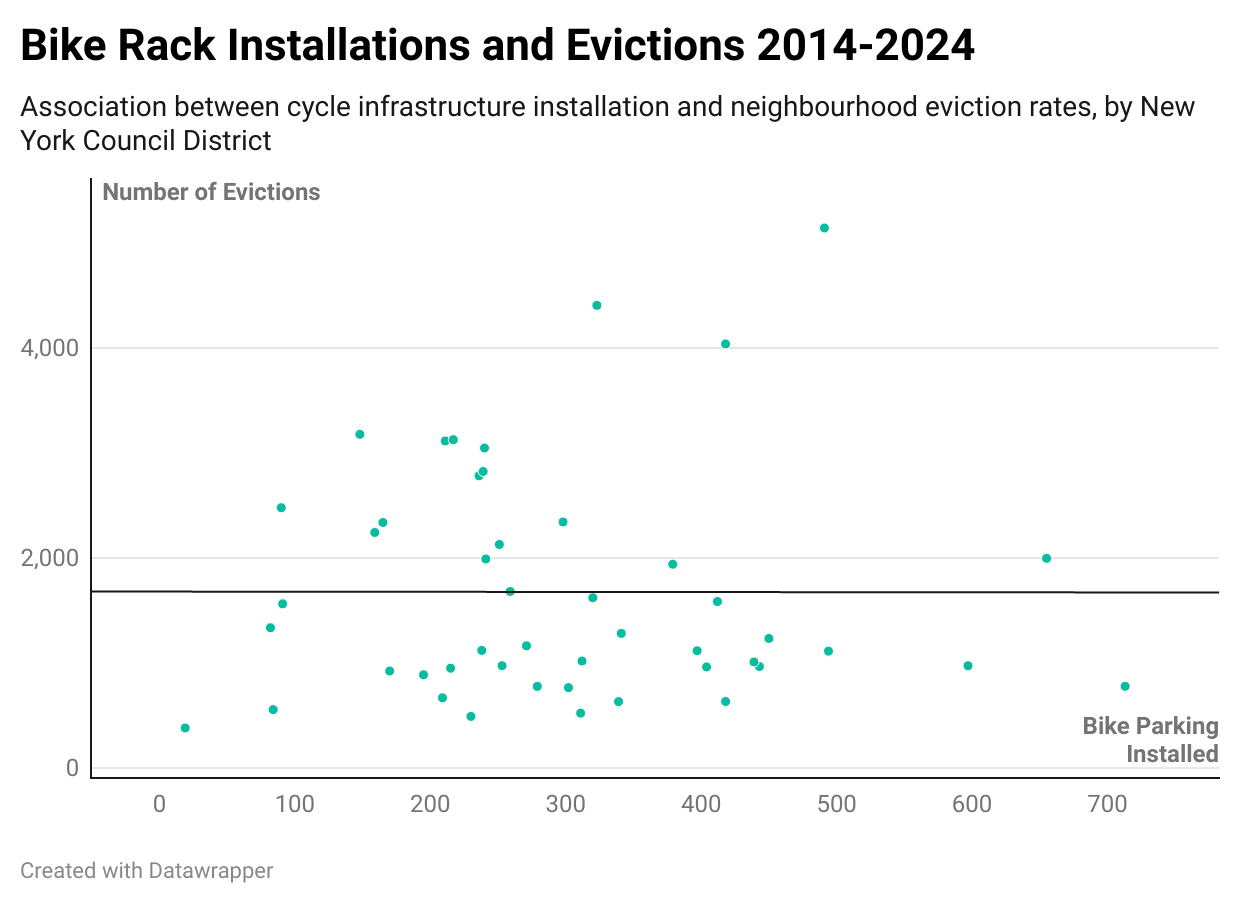
If increased cycling is a cause of gentrification, we would expect to see that infrastructure associated with increased evictions over time. The above graph does not appear to show this - the trend line on the following graph is totally flat, indicating that there is no correlation between the two variables. So, at the level of the 51 Council Districts of New York City, shows that higher numbers of cycle parking installations are not associated with higher eviction rates.
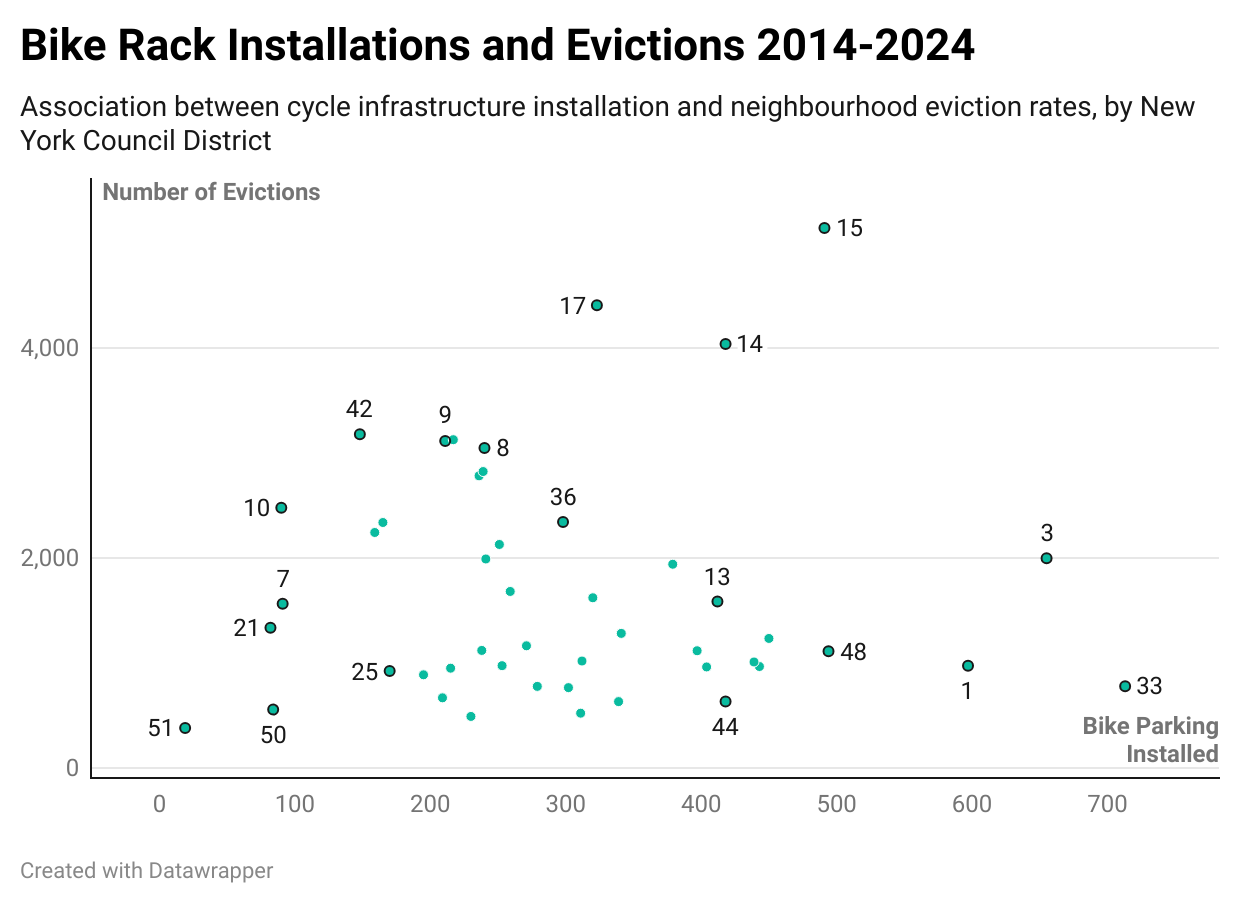
However, some of this might be due to borough-specific or city-specific patterns of city transport needs or evictions, Below, we can see that the most cycle parking was installed in District 33, a high-traffic area in Brooklyn that includes Brooklyn Heights and Williamsburg, and Districts 1 and 3, which are in Manhattan. Both areas gentrified before the 2014-2024 window we’re examining, which might be the cause of their relatively lower eviction rates, and they also experience a lot of tourism and commuting, which might have created the demand for bike parking.
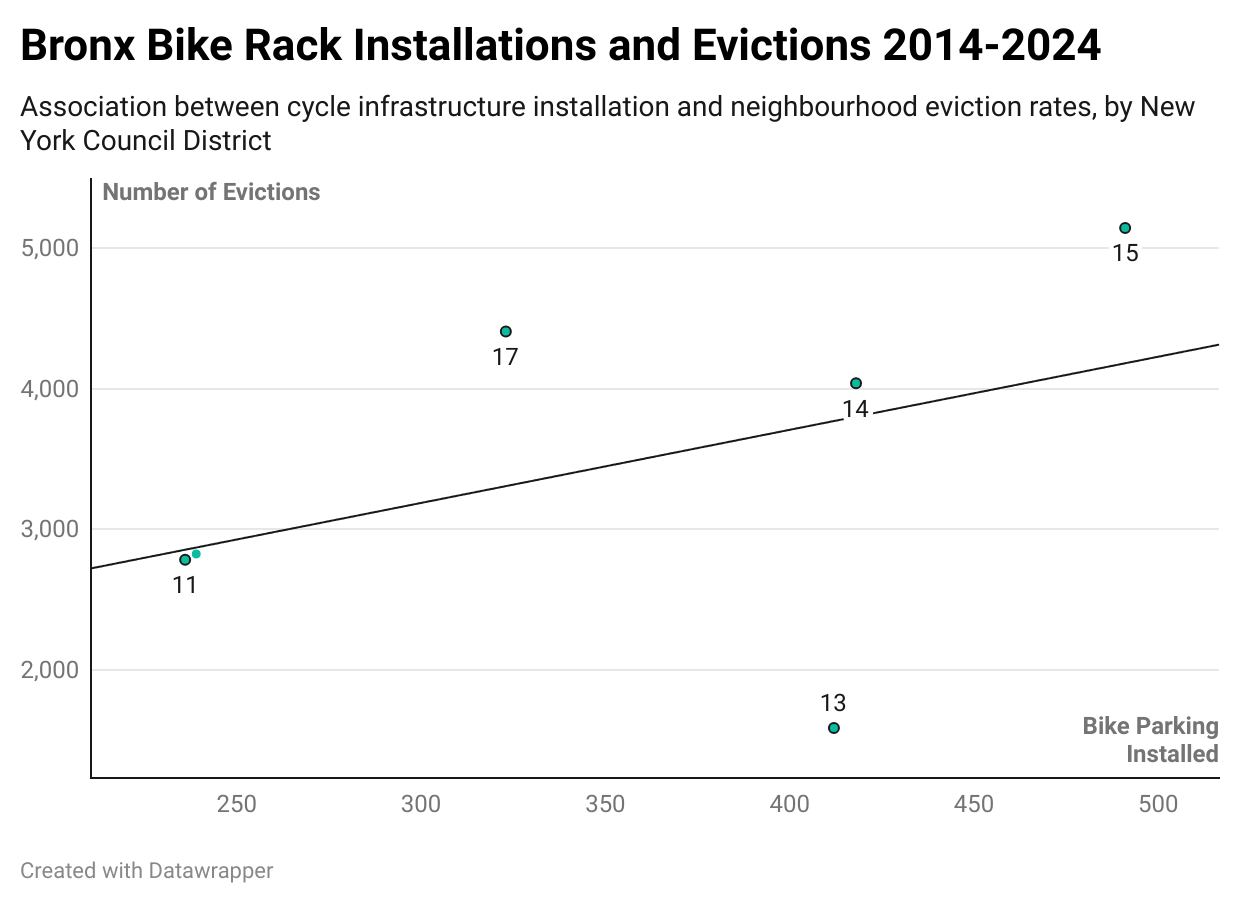
Let’s compare the overall New York trend with just one borough which is changing rapidly but arguably has not yet gentrified - the Bronx. Was Ann’s perception founded? Well, we see a lot of variation even within this borough. Council District 15, in the center of the Bronx, had 491 bike rack installations and over 5000 evictions, while Council District 13 had 412 installations, but an eviction rate around two-thirds lower, at 1587. That said, there is a slightly positive overall trend within the Bronx districts. This doesn’t mean that more bike uptake is the cause of the evictions - they might be due to any number of social, economic, or political events that happened over that ten year period - which covers the Covid pandemic. While the causal link is not clear, there might still be something to residents' perceptions that more bike parking is associated with changes to the neighborhood that include demographic shifts.